Photographer Una Burnand
Fashion Abena Ofei at Wizzo & Co
Groomer Julie Read at Carol Hayes Management using Elemis and Bumble & Bumble
Writer Dana Reboe
Fashion Assistant Joshua Cornejo
A self-proclaimed old soul, George Jaques contains multitudes. An actor, a writer, a director, and a businessman — each hat comes with its own set of rules. He swaps them in a way that looks easy, finding the grit to make the art he wants to see. It takes guts to be so bold, to find your voice in a world that’s enveloped in so much noise. But he was determined to be heard. And that takes confidence that can’t be bought. George started a production company at the age of 16 to tell stories that express all shades of life. He wants audiences to laugh, cry, or do both at the same time.
Aspiring to the next big thing, then the next, and then the next, he doesn’t take any of it for granted. With his most ambitious project to date, Sunny Dancer is George’s sophomore film, on the heels of Black Dog. It is a coming-of-age story that doesn’t pull its punches or hold our hand; it's heartwarming, authentic, honest, and devastatingly raw. But the journey of making this film and getting it seen by many hasn’t always been easy — in fact, it was hard. In our conversation, George does not attempt to package everything perfectly and neatly smooth it over. As the poem he reads during our conversation suggests, he welcomes all his feelings. It was hard, it was beautiful, it was chaotic, and he has yet to really reflect on any of it. But in the midst of the whirlwind, Jaques sits down to chat with us about it. A temporary respite, but a much-needed one, he’s brimming with a barely contained pride that is nearly blinding.
Fresh from our photoshoot, we delve right in. He’s still buzzing from the screening of Sunny Dancer the night before, where popstar (and legend) Kylie Minogue made an appearance. It all seems so unbelievable: the recognition, the names sliding into his DMs, and the breakneck pace at which the dominoes are falling into place. It’s overwhelming, it’s incredible, but most importantly, it’s well-deserved. He’s taking everything in stride, enjoying the wave while it crests, but looking forward to when it troughs, too.
Sunny Dancer is out now in select UK cinemas.
George: Did you put the film posters up just for me?
[laughs] Yeah, absolutely. Do you have a favourite?
‘Pulp Fiction’ is pretty good.
It is. There's also a Frankenstein one up there, too.
Wow, you've got it all going on. Are those your favourite kinds of films?
I lean more into Frankenstein. I love Guillermo del Toro. I'm also really looking forward to Werwulf, directed by Robert Eggers. Have you seen Nosferatu?
I haven't seen it, which is outrageous because my agent reps Lily-Rose Depp. It's definitely on my watch list. I've been so wrapped up in Sunny Dancer for so long that I feel like I've not watched anything. It’s quite a dark film, and I need to be in the right mood.
What are you most looking forward to once the madness of press and premieres is over?
Reflecting. It's really hard to reflect on what you've done and what you've achieved when you're in the middle of it. You go from one thing to another — you're in a photo shoot, and then you're doing an interview, and then you're doing a screening. Last night, Kylie Minogue came to a screening. Those [sorts of things] are such massive achievements, but it's so easy to get swept up. I'm still like, “Oh shit, Kylie Minogue came to the screening yesterday!”
So, what I’m hearing is you haven’t had a second to breathe.
No. Since Berlin, it's been nonstop. We only shot the movie last year. The Sunny Dancer journey has been very fast and very hard in an amazing way.
That’s incredible. When you were conceptualising the movie, what did early iterations of the script look like? Was it always going to be a mishmash of these misfit characters, or did it look different?
I always knew I wanted to make a comedy about cancer. My mum had cancer when I was growing up. I wanted to touch that subject, but in a really different way. I think cancer films are a weird subgenre. There are some big tropes that I was keen to avoid. I wanted to write a film a bit like The Breakfast Club. There are 80s and 90s ensemble films where you can really see each of those characters as someone for everyone. I was excited to bring that into a cancer film setting. I met many young people while working with Teenage Cancer Trust. A lot were in remission, and you realise how full of life they are and how cancer is the least interesting thing about them.
When you sit down to write a story like this, or any story, do you find yourself going in chronological order? Or do you drop yourself in the middle of a scene and work your way around it?
It’s interesting, because my editor edits that way. Caitlin Spiller, who works with me, will drop herself into the middle of the scene. She works from the bit she finds most interesting. When I'm writing, it's a bit different. I come up with a list of moments.
In Sunny Dancer, it might be Ralph being sent home or an outrageous joke. It could be Neil Patrick Harris talking about his son or the photo wall. I’ll put them in an order that makes sense to me. Then I just write from one to another. So, it's almost in chronological order. Sometimes I'll skip over a few scenes. If I get really stuck with writing, I might jump to the end and then come back since I roughly know where I'm going.
You've said that writing made you fall in love with reading. What was it about that process that made you fall in love with reading books?
When I was growing up, my sister was a massive reader. She did English at Oxford, and I didn't. Reading books was such a task. I remember being like, “This is so long.” My attention span wasn't great. I'd pick up a book, probably get 30 pages in and then be done.
When I started my production company at 16 and writing theatre, I wanted to have more knowledge about that world. I started reading plays. You can get through them in two hours, which really helped at first. I'd go on holiday and read so many in a week. From there, my writing started to get bigger, and eventually I found the same love for reading books. Whenever I read a script, I imagined it on a stage, even if it was meant for film.
Do you have staple plays you find yourself going back to? Are there any books that you reread for comfort?
There's a play called Sea Wall by Simon Stephens. It's a short play that Andrew Scott did. It then went to Broadway, and I think Jake Gyllenhaal did. It’s amazing. It's just so harrowing and beautiful. Simon taught me to write when I wrote my first play. He was my mentor for a few years. He read a lot of my writing. I did loads of rehearsed readings when I was acting more. Jude Law and I did a lot of Stephen’s plays together. It became very organic.
I go back to it whenever I am writing because it reminds me not to overcomplicate things. Book-wise, it would be A Grief Observed by C.S. Lewis. A lot of my work at the moment has grief within. [The book] describes grief as feeling like fear. I think that's a beautiful statement. I made my cast read that for Sunny Dancer. I've got a poetry book now by The Poetry Pharmacy. For every emotion you feel, it has a poem.
There's this amazing poem called “The Guest House.” I find myself reading that a lot. I'll read one line from it. It says, “This being human is a guest house. Every morning, a new arrival. A joy, a depression, a meanness, some momentary awareness comes as an unexpected visitor. Welcome and entertain them all!” Whether you feel sad, happy, or jealous, welcome that in, but don't let it stay and take everything from you.
I love that because every emotion shouldn't be stewing inside.
It's other people's emotions, too. We did this amazing scheme where we played Sunny Dancer for free in 120 cinemas across the UK for people who couldn't afford cinema tickets. Last night we did a screening for Teenage Cancer Trust. Many young survivors were there. It’s a lot to take in sometimes. People are really affected by the piece, and I'm so proud of that. But you also can't hold everyone’s emotions, because otherwise you'll explode. But there is a responsibility. People connect to it and want to tell me their story, which is beautiful. My DMs are full of people who really connect to the work. That's an amazing feeling.
It must be. I have to say, after watching the film for the first time, I was going to start this interview with: “How dare you?” I was a mess.
Brutal, right?
I was ugly crying. So, thank you so much for that.
Sometimes you have to have a big cry. I'm so proud of that ending. Because you’re so lost in the film, it hits much harder. There's something so remarkable about what Bella Ramsey is doing. It’s so raw. Bella had nothing to hide. When I cast Bella, the only fear I had was that they'd been in such massive worlds, from Game of Thrones to The Last of Us and Catherine Called Birdy.
The biggest response we've had has been people being so grateful for life. You leave going, “That was a journey, but she's going to be okay.” I remember writing it while in the edit of Black Dog. I always say Black Dog grew up with me. I wrote that when I was 18, and I shot it when I was 21. But this film feels like I graduated and then got to make this.
How are you feeling now that the film has come to fruition?
It’s been mine for so long. Even when you're doing the festival circuit, it still feels quite yours because you're selling the movie. We're so lucky that we're releasing the movie around the world. That doesn't happen with Indies that often.
I’m proud. I worked on the campaign, marketing, and everything for so long. Now it really feels like handing it over. There's no reluctance. It's just pure excitement. It feels like a massive end of an era for me. This was my sophomore feature, and it was a huge, huge step up from Black Dog. A hard step up.
There’s award season if the film goes that way. I have no doubt Bella's going to win everything. I hope that in five years, someone going through something hard, whether it's cancer or not, feels seen. There's a character in there for everyone. It's going to be with me forever.
I know you're in the midst of Sunny Dancer madness right now, but have you started thinking about your next film?
I can't say much about it, but it's all written, and we're going to start casting.
That’s exciting!
It’s mad. I just adapted my first book for screen. I've got quite a few TV shows we're working on. My company is in a real moment of growth. We're turning ten in April 2027. That's a huge chunk of my life. By the time I'm 30, I would have been doing this for half my life. We now want to be a hub for talent.
We want to create projects that make you laugh and cry. We want to blend film, fashion and music closer together. We worked with Este Haim on Sunny Dancer. I want to work with brands, but across theatre, film and telly. I want to make theatre shows, TV shows, films where you think you know what's going to happen, and then it turns what you know on its head.
How mind-blowing was it for you to get Bella on board? I read that you sent them a campy video, and when they agreed to sit down with you, you spent two hours on Zoom.
Bella and I didn't know each other before this process. Bella's name came up, and I was like, “Well, there's no fucking way they’re going to do this. They’re the most famous young person on the planet.”
Their agent, Georgie Adams, who's now a close friend of mine, read it. They loved it and messaged the casting director. Two weeks later, I got an email saying, “Bella's read it and would love to meet George.” All my execs called to tell me, “If you get Bella, it's a massive deal.” I was like, “Yeah, I fucking know!”
Bella was in rehearsals for series two of The Last of Us, doing stunt training. I remember saying, "Look, I just want to start this Zoom and say: I really want you to do my movie. What do you want me to say that's going to convince you to do it?” Bella was like, “Oh, I want to do the movie.” Then we just spoke about life in a really organic way.
We spoke about everything from times in our lives when we have felt othered. We spoke about cancer. We spoke about being young. We spoke about all the themes in Sunny Dancer. It was magic. They’re the beating heart of this film.
I truly feel like you captured lightning in a bottle with the entire cast. I particularly loved how resistant Ivy is to everything at the start. Eventually we see her embracing and falling in love with life again. Why was it so important for you to show that transition on screen?
Bella uses they/them pronouns, and Ivy uses she/her. But I wanted to go from a young girl, Ivy, who's angry and fucked off at the world. I wanted it to be that she falls in love with these people, the world, and then herself. For me, certainly in my life, there have been moments when I've not loved the world, and I felt angry. When my mum was diagnosed, or when we lost a mate growing up, there were moments where I'd be like, “Well, fuck this. Why?” So many young people go through that. I always say that the moment you grow up is the moment you experience grief for the first time.
I was fascinated by the idea of being closed off, but still wanting affection. It's a bit of a catch-22. We've all gone into those moments when you're like, “I'm going to be so fucking over these people. They're all weird. I don't like them.” Then you take a step back and think, “Maybe I'm one of them, and that's quite special.” We've all felt othered in our lives.
You’ve mentioned working with the Teenage Cancer Trust; your mum had cancer while you were growing up. How did those experiences inform you as a person and as a creative? How has that seeped into your work?
As a creative, and for Sunny Dancer, it was everything. I worked with Professor Rachel Howe, who's a blood doctor. She works with young people with leukaemia. She would teach me about the medicine they use, dexamethasone. It isn't called dexamethasone in the lived-experience world; they nickname it dex. Originally, it was Jake, Daniel Quinn Toye's character, who had a stem cell transplant from his aunt. She was like, “That's not possible. It would be his sister.”
Although the film isn't about the medical side of cancer and its kids in remission, it was important for me to get it right. We did an open casting with Teenage Cancer Trust, and I cast two young people with lived experience of cancer in the film. I got to spend a lot of time with young people who would tell me about their first snog and all the naughty stuff.
You just really get to learn their language. I got to meet a lot of parents who had lost their children as well. This film wouldn't be what it is without the Teenage Cancer Trust and without my mum having cancer and surviving. I was lucky in that sense. But it was such a tumultuous time. That really shaped the film. We pushed it to be right. We paid for everyone's therapy on set. It's the proudest thing I've ever done: casting two young people in the film who have had cancer, and now they have agents and are smashing it. How cool is that? I care about the stories I tell, but I also care about family and friends much more deeply now because of this movie.
What's something that you've learned from Black Dog that you’ve carried with you to the set of Sunny Dancer? And what's something that you've learned from Sunny Dancer that you'll carry into your next film?
On Black Dog, I learned the art of collaboration and running a set. I take the work seriously, but I don't take myself that seriously. Black Dog was hard because it was such a small movie. It was filmed in four weeks. But we laughed a lot, and we got through it as a team.
I always rehearse in films. That's because of my theatre background. I think everyone knows what's in my head. We're all pointing in the same direction and making the same movie. And that's something that a lot of people don’t get right. Neil Patrick Harris knew what I wanted. I knew what he wanted.
I wrote letters to the cast on their first day of Sunny Dancer. I've been an actor for a long time, and I've sat in hotels before a big day on set. I wish someone had done that for me. My process has been really solidified. Ask me what I have learned on Sunny Dancer in a year, when I have more time to reflect.
So, same time next year?
I'll probably say something like, “Don't burn out.” Opening a movie theatrically around the world is not easy. We're running as a little group that's making this happen and making the impossible slightly possible.
You’ve talked about The Breakfast Club before, and I get the sense that you like 80s movies. You've also called yourself an old soul. What were the films and the art that helped build your ethos as a person?
I grew up going to the local pantomime at Christmas or watching Gladiator with my dad or gram. I watched Christopher Nolan and Sofia Coppola's films a bit later. I was never a movie buff growing up. It’s been a bit of a journey. But my grandparents had four DVDs, and one of them was Little Miss Sunshine. I remember watching that film repeatedly. It's beautiful. When I started writing Sunny Dancer, Little Miss Sunshine was in my mind.
Juno was also on my mind because I love how she's a young character who speaks like an adult. And I remember when I watched The Breakfast Club, I was blown away by how timeless it felt. I felt like I knew those guys at my school. Dead Poets Society inspired me as well. What I love about all of those coming-of-age movies is the timeless quality.
Is there a particular line of dialogue or scene from your own work or work you've been in that has stayed with you?
There are a few in Sunny Dancer, like Jess Gunning's monologue, when she says, “Isn't it amazing that you got to experience a love like this? Some people wait their whole life for it, and you've got it.” I remember Jess delivering it, and I was so proud. Another one is Neil saying, “There was a time in your life when you would want to be this girl here at camp more than anything.” And one of Bella's improvs always gets me. It’s when they're in the water floating, and Bella goes on about Jake’s blue eyes. I was like, “You are actually a fucking genius.”
In Black Dog, they really speak so openly about grief. There's this moment in the movie when they're in the car, and they've just buried one of the boy's mum's ashes. It just started raining. I remember that being such a poignant moment.
I was in Serpent Queen, which was one of my lead roles. Samantha Morton and I had a scene where I was on my deathbed. There was a line like, “I didn't know it would hurt this much.” I always come back to that. I also did a show with Jude Law when I was 20, and there was no dialogue. Jude’s character was being sacrificed and killed. That was poignant as fuck. My favourite line I've ever delivered was, “Dad, dad, dad, I just stabbed the guy, stabbed him right up his arsehole.” That might have been improv, which sort of says a lot about me.
The film is such a beautiful lesson in grief and finding that light in the heaviness of it all. What has been your light in the past?
I didn't have a great time growing up. I never felt like I knew where I fit into the world. The industry was a big change for me. I found a lot of solitude, friendship, and love. I felt really accepted. Not everyone gets that opportunity.
I also find that I'm the calmest when I'm near water. I grew up in London. My dad was a boat builder in Devon. My mum is by the seaside now. I go there to be a bit more grounded. It's been mad. We're in Vogue; we have Geri Halliwell coming to things; I got a message from Sam Rockwell and all these amazing people. I’m just like, “What the fuck?” I like taking myself back to Simon Stephens, who says to me, “Whenever you're overwhelmed about the world, just take yourself back to the kid you were when you were 16, who wrote that play in your room. Yes, the rooms are a lot bigger, but that guy's still there.”
I went to therapy for a long time. I keep a shelf in my house with pictures of me as a child. It’s like, “Yeah, I'm still that guy.” I'm really proud of what I've achieved in the past 10 years. I'm proud that I've never fucked anyone over. When there's a lot of madness, I try to recenter myself.

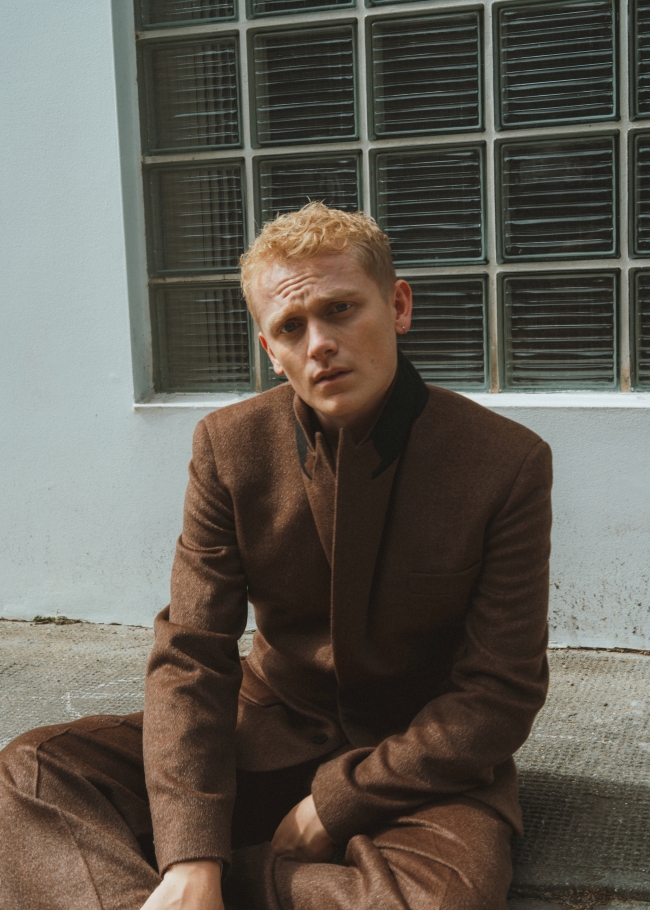
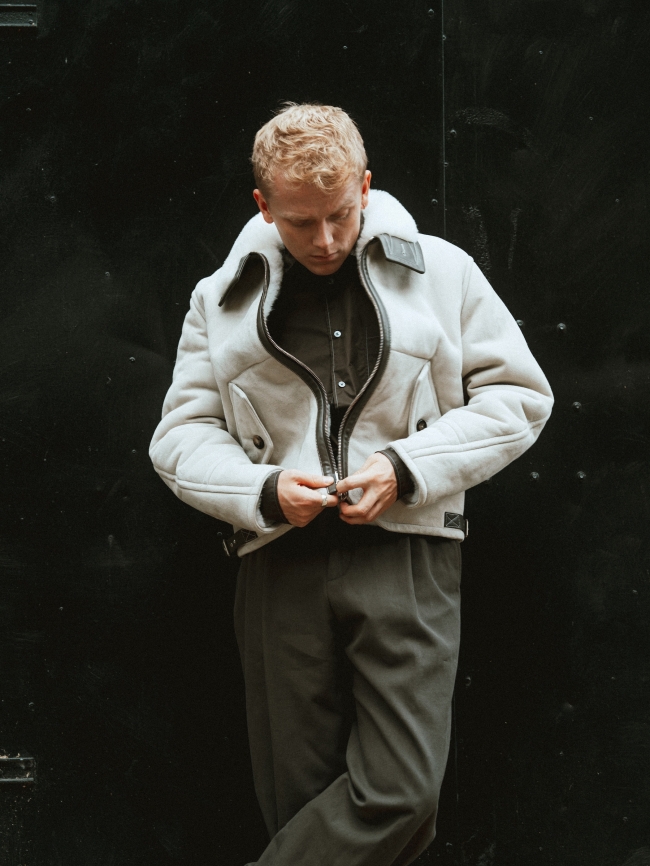
Above left: George wears Jacket and trousers by IM MEN, Vest by Arket, Belt by J&M Davidson, Socks by The London Sock Company, and Boots by Hermés
Above right: George wears Full Look by Dior and a necklace and gold rings by Tom Wood

Above: George wears Full Look by Paul Smith and Signet Ring by Tom Wood


Above left: George wears Full Look by Hermés, Ring by Tom Wood, Socks by The London Sock Company, and Boots by Hermés
Above right: George wears Look as Before


Above left: George wears Full Look by Louis Vuitton and Silver Bracelet and Ring by Tom Wood
Above right: George wears Look as Before


Above left: George wears Look as Before with shoes by Louis Vuitton
Above right: George wears Look as Before
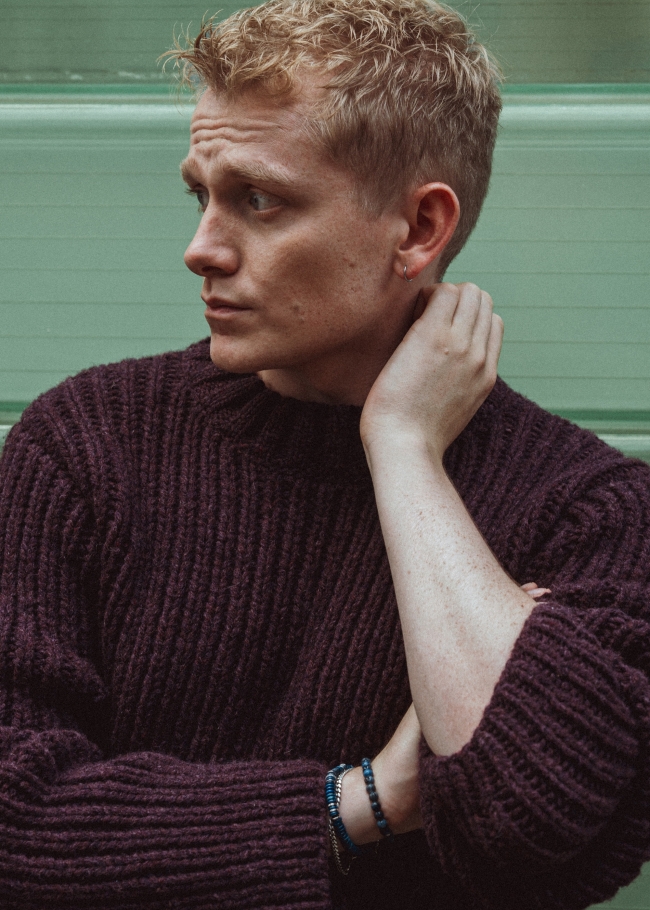

Above left: George wears Full Look by Prada and Bracelets by Tateossian
Above right: George wears Look as Before


Above left: George wears Look as Before with Shoes by Grenson
Above right: George wears Look as Before